The Native Renaissance: Why AI Agents Might End the Cross-Platform Compromise
For a decade, cross-platform frameworks offered a practical compromise. But as AI coding agents eliminate boilerplate and reduce maintenance costs, native development is poised for a major comeback.
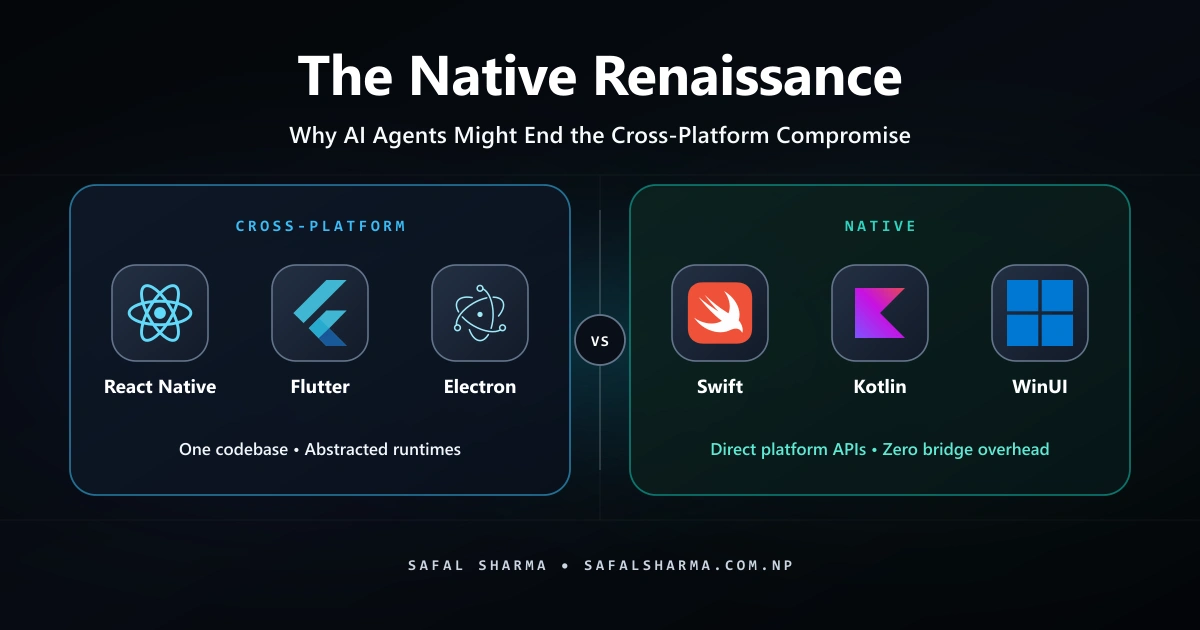
The Native Renaissance: Why AI Agents Might End the Cross-Platform Compromise
The 10-Year Compromise of "Good Enough"
For the last decade, the software development landscape has been dominated by a single, seductive promise: "One codebase, deploy everywhere." Frameworks like Electron, React Native, Flutter, and Xamarin rose to power by offering a tantalizing shortcut. Why spend twice the time and budget building separate iOS and Android apps when a single team could write code once and ship it to both platforms?
Software Development Was Costly
Software development used to consume a significant proportion of time on writing code and debugging. IDEs got much better over time and removed a lot of the burden of writing boilerplate code with crazy autocompletion, hints, and refactoring capabilities. However, they had their limits as well.
The programming languages and SDKs for native development are generally complex and require significant time and effort to master. Furthermore, that mastery remains bound to a specific platform. iOS developers could not easily contribute to Android development, and vice versa. This naturally meant x times the cost and time to support x number of platforms.
Developer Incentives to Adopt Cross-Platform
Developers, of all humans, couldn't resist the versatility of developing across multiple platforms. For some, it meant being able to launch their apps everywhere at once, while for others, it simply meant more job opportunities. Some might even argue that developer experience started becoming a priority over user experience.
Cross-Platform Progress
To be fair, cross-platform frameworks delivered on their promise. They enabled startups to launch MVPs rapidly and allowed established companies to maintain a consistent brand presence across platforms without the overhead of maintaining two separate engineering teams.
Popular frameworks like Flutter and React Native have come a long way in terms of performance and developer experience. They are able to leverage native capabilities to provide a near-native experience to users.
For a significant portion of content-driven apps, e-commerce platforms, and internal business tools, the trade-offs were—and still are—acceptable. Performance differences are often negligible for the average user, and the time-to-market advantages are significant. However, the story for certain types of apps is very different.
The "Good Enough" Threshold: Where Cross-Platform Falters
The "Electron-ification" of Windows is an interesting phenomenon to observe (as highlighted by XDA Developers).
To maintain the same developer and user experience across platforms, cross-platform frameworks have to abstract over native capabilities. This abstraction comes at a cost.
For example, my team once had to build a desktop app utilizing Bluetooth Low Energy (BLE). We didn't have much time or expertise in native development, so we opted for an Electron-based app. The developer experience was familiar for React developers—until it wasn't.
Using BLE on Windows from JavaScript turned into a nightmare, and we had to write a separate Python bridge just to communicate with the native APIs. The app had bugs that we weren't sure how to fix. For a simple BLE-based monitoring tool, RAM consumption consistently exceeded 400 MB.
Agentic Software Development Enters the Chat
We are in a new era of software engineering where we must rethink the software development process. What worked before may not be the best way to solve problems now. AI can write 1,000 lines of syntactically correct C++ code in seconds. That amount of leverage has the potential to change the equation completely.
There are valid arguments that AI currently writes better code in popular cross-platform frameworks due to their massive online communities and documentation. However, native frameworks are catching up quickly with the help of MCP tools and agent-friendly documentation. Even without AI, native Android development with Kotlin, for example, is a far more pleasant experience than it used to be. For some functions, writing Kotlin code is actually faster and takes fewer lines than writing Dart code. Ultimately, the narrower the gap gets, the more attractive native apps become—simply because the resulting app will be faster, lighter, more secure, and will provide a better user experience overall.
Shifting Development Focus: Architecture and Verification
Although current AI models can generate large amounts of code, it is a well-known fact that they struggle with architectural design decisions. These decisions depend heavily on a company's specific needs and constraints. Key criteria include security, scalability, performance, cost, and maintainability. Forward Deployed Engineer roles are on the rise probably for that very reason.
Moreover, software development often involves coordination between designers, product managers, and other stakeholders. This communication overhead does not scale well and becomes a bottleneck. We will have to develop sophisticated workflows to overcome this hurdle. Until then, developers will still have to spend a significant amount of time on these human coordination tasks—tasks that care little about whether you choose cross-platform or native.
That being said, code verification will be one of the most time-consuming aspects of agentic development. Verifying the correctness of code generated by AI agents is a complex process requiring deep understanding of the system as a whole. If we are developing natively for multiple platforms, the verification effort naturally increases, even with AI's help. However, this doesn't mean cross-platform is automatically the better choice; it just means we must be more deliberate when choosing between the two.
Responsibility & Accountability
If an autonomous AI agent crashes a banking application, who is responsible? The developer who wrote the prompt? The company that deployed the agent? Or the AI agent itself? Obviously, we cannot blame the AI agent, so accountability falls on the developer or the company. With native app development, having multiple distinct codebases can increase the verification and maintenance surface area. So here, cross-platform still seems to have an edge in operational simplicity.
On the other hand, cross-platform apps are often more prone to subtle bugs and security vulnerabilities because of the "black box" nature of third-party bridging frameworks. When issues occur deep inside the abstraction layer, diagnosing and fixing them is significantly harder.
Competition Between Fastest Time to Market and Best Performance
Until now, time to market has been the single most critical factor for the success of any application. The faster you can reach users, the more likely it is to succeed. While speed remains vital, AI has made speed table stakes. Whether you choose cross-platform or native development, prototypes can now be built in hours, if not minutes (a shift echoed in Goldman Sachs' analysis on AI agents boosting software productivity).
So, the balance between development speed and runtime performance is already tilting back in favor of native apps. Still, the race isn't settled, as cross-platform performance continues to improve with modern compilation pipelines.
The Memory Crisis
Perhaps not in the long run, but right now, memory prices seem to be skyrocketing. Consumer device makers have already begun either cutting RAM or hiking prices (as seen with reports on the Pixel 11).
An Electron app consuming 300 MB of RAM just to display the weather doesn't seem acceptable anymore—especially when its native counterpart takes only 50 MB. This efficiency pressure could also be a major driver behind Microsoft actively optimizing WinUI 3 to boost Windows 11 responsiveness.
My Take: Will Native Apps Make a Comeback?
Having worked on both native and cross-platform apps, I believe native apps will definitely make a comeback—though not for every use case. Cross-platform frameworks like Flutter and React Native have gotten so good that they will remain the top choice for many applications.
- Go Native: For applications that need to utilize hardware and OS capabilities to the fullest—such as system utilities, high-performance BLE telemetry tools, AR/VR apps, advanced camera pipelines, or productivity software demanding minimal memory overhead.
- Go Cross-Platform: For apps dominated by standard business logic, UI layouts, and API consumption rather than platform-specific hardware features (e.g., most social media apps, e-commerce, news readers).
Developers will need to be more adaptable and flexible in the days ahead. Of course, this is just my perspective—no one can predict the future with certainty.
👏Enjoyed this article?
Drop some claps if you found this article helpful.
From the archive