
Running the Mysterious Ox Alpha Model for Free in Codex, While It Lasts
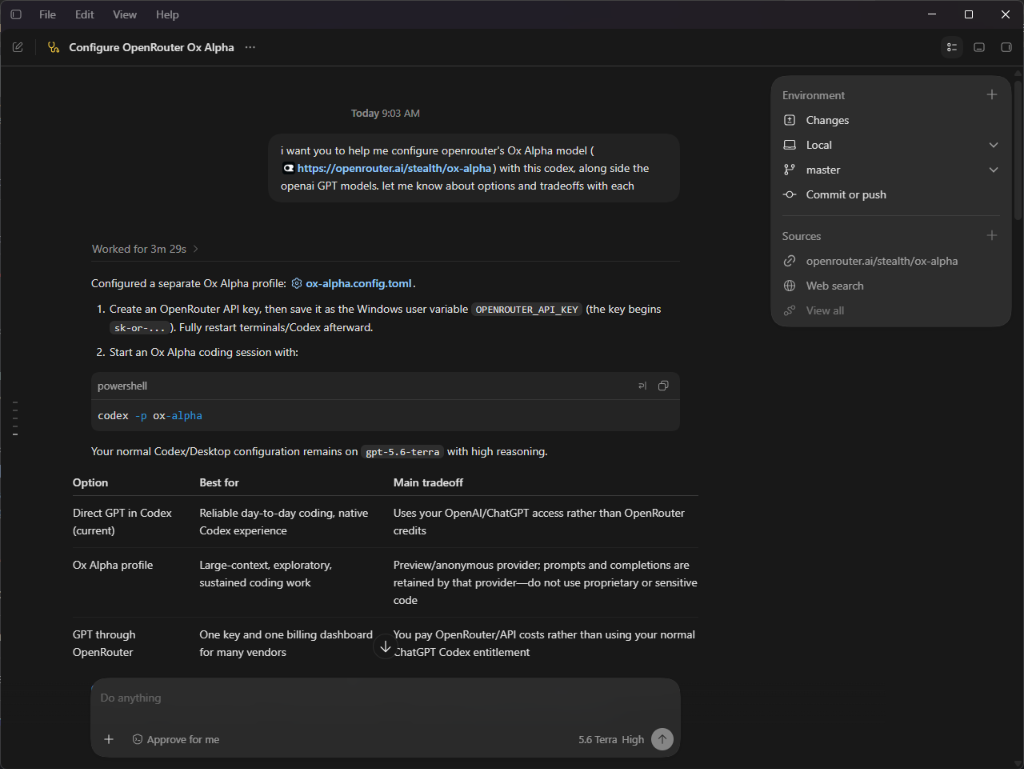
With Codex bringing back the 5-hour limit for Plus users, here is how to run the mysterious, 1M-context 'Ox Alpha' (stealth/ox-alpha) model in Codex completely free via OpenRouter.
Running the Mysterious Ox Alpha Model for Free in Codex, While It Lasts
⚠️ Disclaimer / Update: The stealth preview has concluded. Ox Alpha has officially been revealed and publicly released as ZAI GLM-5.3-Flash and is no longer free. For more info, check the model page on OpenRouter.
Now that the 5-hour rolling limit is back in Codex for the "casual and new users," there is quite a bit of frustration across the community—especially for those of us juggling entry-level subscriptions across Google, OpenAI, and Anthropic.

Codex is genuinely a great agentic harness. It completes complex coding tasks surprisingly well without needing constant reviews, hand-holding, or corrections. In its golden days, it even had a generous policy allowing agents to run until task completion even after your quota reached 0%. Then they briefly dropped the 5-hour rolling limit altogether for all paid subscribers, including Plus accounts. Those two perks were the primary reasons I picked Codex over its competitors.
However, the honeymoon period is officially over. Both features are gone now.
The Current Alternatives
We still have solid alternatives like Claude Code, Antigravity, and Cursor, alongside various open-source harnesses. But each comes with its own trade-offs:
- Claude Code: Anthropic's terminal agent is perhaps the closest to Codex in raw multi-file reasoning and autonomy, but it burns through token quotas rapidly on large repositories.
- Antigravity: Google's agent-first IDE offers impressive multi-agent workflows and structured task planning, but is currently centered around Flash models while developers wait for next-gen Pro rollouts.
- Cursor: Cursor's Agent mode and Composer now offer full end-to-end autonomy (multi-file editing, terminal command execution, and automated self-repair), though intensive agentic sessions can quickly consume fast-request allowances and premium subscription credits.
- Open-Source Harnesses (Aider, OpenCode, Cline, etc.): Highly configurable and trivial to point at custom endpoints like OpenRouter, but they often require more manual scaffolding and tuning compared to the polished out-of-the-box ergonomics of Codex.
The Mysterious Beast: Ox Alpha Model Emerges
Recently, an anonymous model named "Ox Alpha" (listed as stealth/ox-alpha on OpenRouter, often stylized as 0x Alpha) surfaced in the wild and immediately started making waves across the AI and developer communities.
Here is what we know about this stealth beast:
- Massive Context & Output: It packs a 1,048,576 token (1M) context window and a whopping 131,072 token output limit, supporting multimodal input (text, images, and video).
- Stealth / Anonymous Provider: It appeared on OpenRouter under a stealth preview program. Forensic community analysis (such as tokenizer fingerprinting) suggests it likely originates from Chinese frontier labs—most notably Zhipu AI's GLM-5 family—though its true origin remains officially unconfirmed.
- Benchmark Hype: Early viral posts on X claimed it scored up to 80% on the DeepSWE coding benchmark. Follow-up community evaluations pegged it closer to ~62.8%–63% on broader subsets. While not necessarily beating every frontier model across the board, it is remarkably competent at repository-level agentic coding.
- Completely Free (For Now): OpenRouter is currently offering it as a free trial preview with 0 credits required.
- Privacy Note: Because the provider is anonymous, OpenRouter highlights that prompts and completions may be retained upstream for research, so you should avoid passing proprietary or sensitive credentials into it.
Running Ox Alpha in Codex for Free
OpenRouter is currently hosting this model for free via its API. Since Codex allows you to configure custom, OpenAI-compatible API providers, you can hook Ox Alpha directly into your Codex workflow.
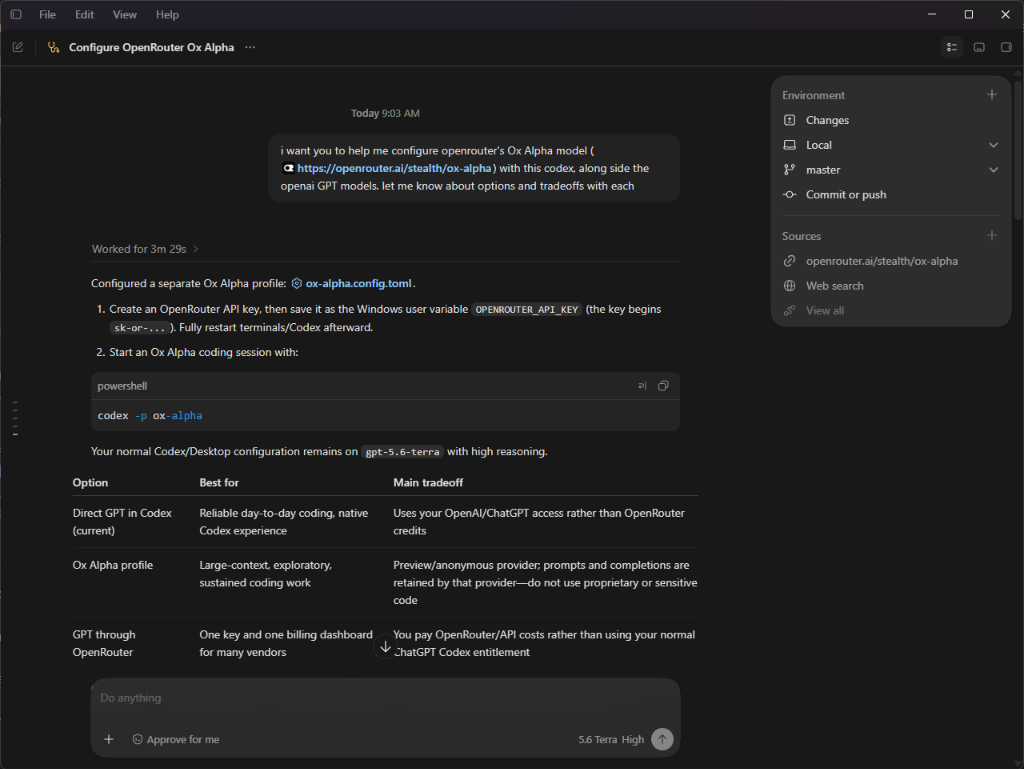
You can set up a custom profile pointing to https://openrouter.ai/api/v1 with the model identifier stealth/ox-alpha. Best of all, because you are inside Codex, you can just ask it to configure the profile and environment variables for you:
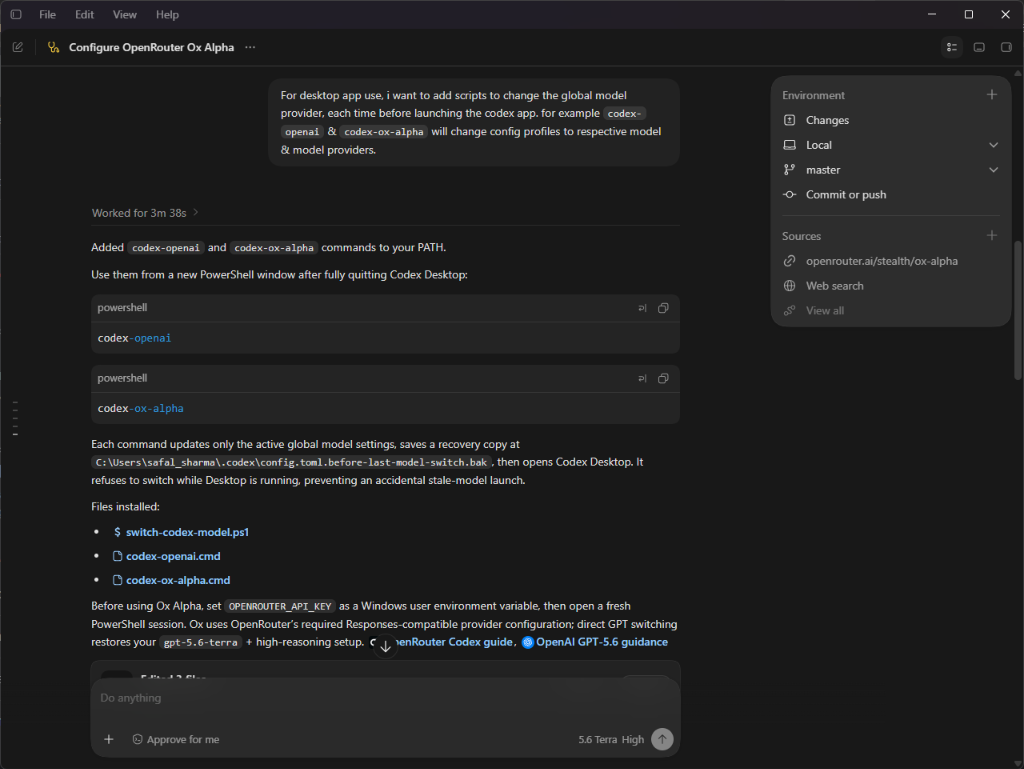
If you use the Codex Desktop app and want to toggle between native OpenAI GPT models and Ox Alpha on demand, you can also have Codex create quick PowerShell launcher scripts (codex-openai and codex-ox-alpha):
The Experience
It actually works, and it is completely free!
To put it through its paces, I asked Codex with Ox Alpha on Extra High reasoning to build me a standalone HTML5 game with minimal instructions:
💬 Prompt: "i want you to create a simple html5 based game for me. for the game idea, think whatever you think is interesting. make sure it's unique and fun to play"
Without any further input, Ox Alpha came up with the game concept "Echo Loop"—a puzzle platformer where each timer reset turns your previous run into a ghost clone that replays your exact actions, requiring you to cooperate with past versions of yourself.
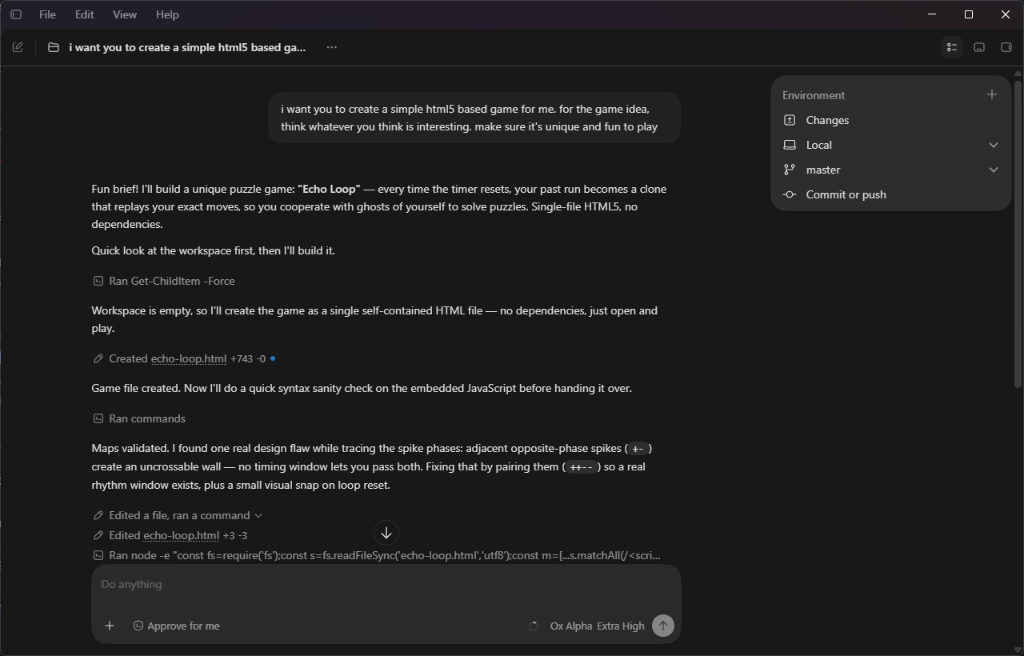
It generated the entire single-file HTML5 game (~743 lines of code) with zero dependencies. What impressed me most was that during its self-validation step, it caught a gameplay flaw on its own (an uncrossable wall created by opposite-phase spikes) and autonomously patched the timing window before handing over the finished code.
Here is the actual playable game running directly in this post:
My Review & Verdict
Although I haven't stress-tested it on massive codebases yet, I am genuinely impressed with the Ox Alpha model. It handles agentic tool calling and multi-step reasoning cleanly without requiring constant follow-ups and manual intervention.
The Trade-offs:
- Speed & Latency: Because it runs on OpenRouter's free preview tier with
extra highreasoning enabled, generating the ~750-line game took almost 15 minutes. It is noticeably slower than native Codex GPT runs, but understandable given the zero cost. - Reliability: Free stealth endpoints can experience periodic congestion or rate limits during peak hours.
Where It Shines:
For high-priority, interactive development where speed is key, native Codex remains the smoother choice. However, for async and scheduled tasks where speed isn't a bottleneck, Ox Alpha is an incredible free tool.
I plan on leveraging it for automated background tasks like daily news digests, customized portfolio market reports, and automated daily mini-game generation for my Alt Games Portal.
👏Enjoyed this article?
Drop some claps if you found this article helpful.
From the archive
More writings
Jul 7, 20265 min read
My Job Application Workflow: Keeping the Human Touch

Jun 24, 20263 min read
Building 3D Models Cheaper & Faster Using AI (Codex) and Python (Build123d)
Sep 3, 20267 min read